


The California Science Center reached a major milestone last week by installing the first artifacts in its new aviation gallery, marking the latest phase of progress for the massive expansion project in Los Angeles.
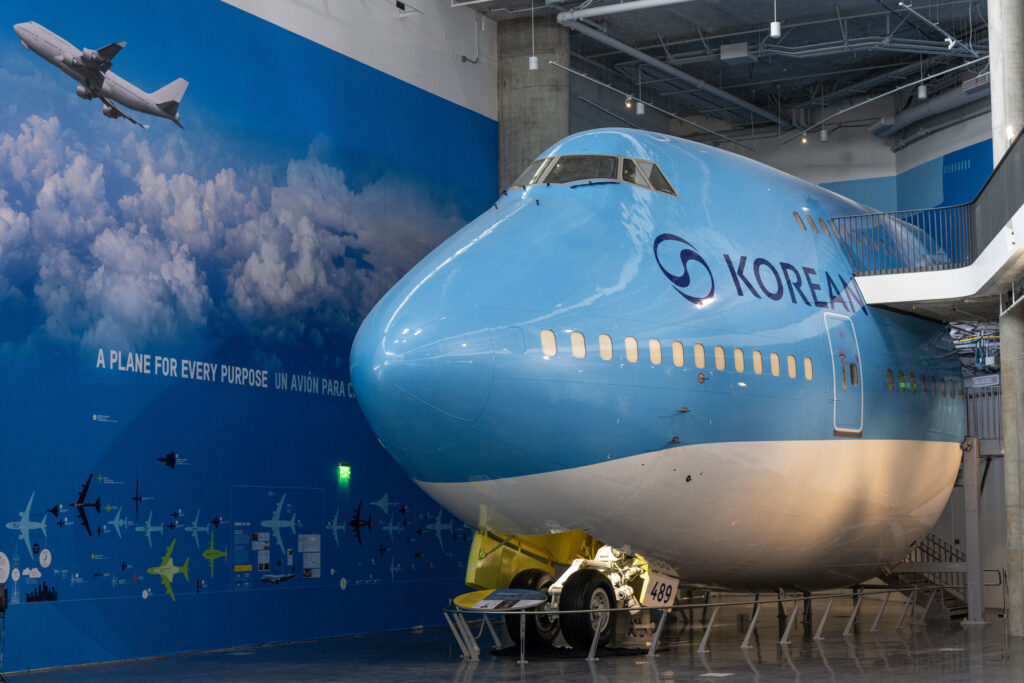
Crews installed a 70-foot forward section of a Boeing 747-400 fuselage along with four suspended aircraft inside the Korean Air Aviation Gallery. The installation represents the first wave of approximately 20 aircraft that will eventually occupy the exhibit space.
The exhibit, called the 747 Experience, includes the cockpit and upper and main decks of the commercial aircraft. As part of the experience, visitors will be able to participate in a simulated flight from Los Angeles to Seoul, Korea, inside an onboard theater.
It’s the latest hurdle cleared in recent weeks following the completion of the greater structure surrounding the historic Space Shuttle Endeavour, which was moved into an upright position in 2024, and was connected to real solid rocket boosters and the last-surviving “flight-qualified” external tank.
Read More: National Geographic to open Museum of Exploration in Washington
The 747 Experience is another massive component of the California Science Center’s expansion, and was funded through support from Korean Air, a major donor to the project.
“For more than five decades, Los Angeles has served as a second home for Korean Air, and we are proud to support the California Science Center’s mission of innovation,” said Walter Cho, chairman and CEO of Korean Air and Hanjin Group. “Our vision for the Korean Air Aviation Gallery is to spark curiosity and wonder in the next generation.”
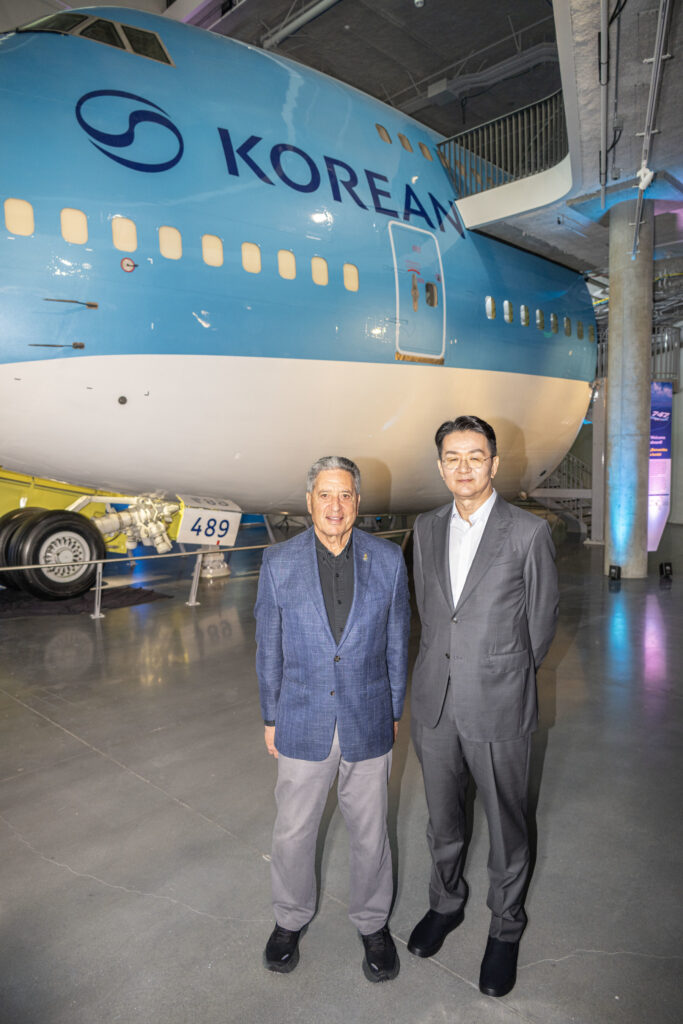
and CEO of Korean Air and Hanjin Group.
Cho joined museum officials at the site Tuesday to mark the artifact arrivals, which also include a Grumman F11F-1 Tiger supersonic fighter jet and a Hawker Siddeley Harrier T.4, which was the first jet with operational vertical takeoff capabilities and the initial artifact placed in the gallery.
Museum officials said the aviation gallery is designed to explore the tradeoffs between lift, thrust, drag, and weight. According to promotional materials from the museum, guests will be able to utilize a “wind tunnel lab” to investigate how these forces interact, and a “Design a Plane” exhibit will teach visitors how aircraft are engineered for specific flight missions.
Construction on the building for the broader Samuel Oschin Air and Space Center concluded in April, and the facility is now undergoing an extensive artifact and exhibit installation process that will continue for several months. Museum officials have not yet announced an opening date for the expansion.
The 200,000-square-foot Phase III expansion spans four floors and doubles the educational exhibition space at the facility. It will feature 100 artifacts and 100 interactive exhibits divided into three main areas: the aviation gallery, the Kent Kresa Space Gallery, and the Samuel Oschin Shuttle Gallery.
California Science Center is nearing completion
The latest artifact installations follow the completion of the center’s most complex engineering feat. Earlier this year, workers finished assembling the authentic space shuttle stack in a vertical, ready-to-launch configuration that stands 180 feet tall. That display includes the flown orbiter Endeavour mated to solid rocket boosters and an external tank, which was enclosed by a towering vertical structure during a multi-year construction project that broke ground in 2022.
“Together, we are creating a one-of-a-kind educational resource that will benefit not only the children and youth of our shared Los Angeles community, but will inspire future generations of scientists, engineers, explorers from across the globe,” said Jeffrey Rudolph, president and CEO of the California Science Center.
As of last month, the California Science Center Foundation had raised more than $393 million toward its $450 million fundraising campaign goal for the project. Donations for the outstanding balance are still welcomed and appreciated.
The rest of the California Science Center remains open to the public while the final work continues on the Air and Space Center. Admission to the museum, which is accredited by the Association of Zoos and Aquariums and the American Alliance of Museums, is free.
For more information, click here.
