

The U.S. housing crisis experienced a rare slowdown briefly in 2024, according to a recently released analysis from Zillow.
For the briefest of moments in time, the first since the 2008 real estate and financial collapse, America’s housing shortage remained relatively unchanged instead of growing like it has in every other year.
So, what happened?
According to Zillow, the answer is actually somewhat obvious and predictable: more homes were built.
Zillow research showed that a “record wave” of apartment construction could be attributed for the stalling of the U.S. housing crisis.
In 2024, the national housing shortage was around 4.7 million homes and that number has continued to grow. But for that single year, behind that record wave, the housing deficit didn’t shrink but grew only slightly.
Read More: Bezos ex MacKenzie Scott donates $70 million to Meals on Wheels
Zillow analysis from a recent American Community Survey data found that from Jan. 1 through Dec. 31, 2024, the housing deficit grew by only 43,000. Compared to the 4.7 million national shortage, that’s less than a 1% increase.
The housing crisis “effectively stalled,” according to Zillow officials. But, unfortunately, a slight increase is still an increase and there’s few signs pointing to the U.S. playing catch-up to the big number anytime soon.
“Stopping the bleeding is progress, but making a real dent requires more than the status quo,” said Zillow’s senior economist Orphe Divounguy. “Behind every missing home is a family doubling up, unable to find or afford a place of their own.”
Zillow says it defines the housing deficit as “the number of families sharing a home with another family, minus the homes sitting vacant and available to rent or buy.”
In 2024, to catch up with the surging demand during the coronavirus pandemic, the U.S. added 1.4 million homes, while the number of families sharing with another rose by “only” 26,000.
Since then, builders have begun “pulling back” from new projects, permit applications are falling, and Zillow says home construction is likely to return to normal, less-aggressive levels.
Where the housing crisis is worst and why
Zillow affordability data tells a story of a sharp decrease in affordable home offerings on the market, beginning in 2021 when about 52.4% of listings on the platform were considered affordable for a median-income family.
In the years since, that number has sharply declined due to rising interest rates and soaring home prices.
By 2024, the number of affordable listings was at a multi-year low with only 29.1% of homes deemed affordable for median-income families. But after that big building year, the number has risen slowly in consecutive years.
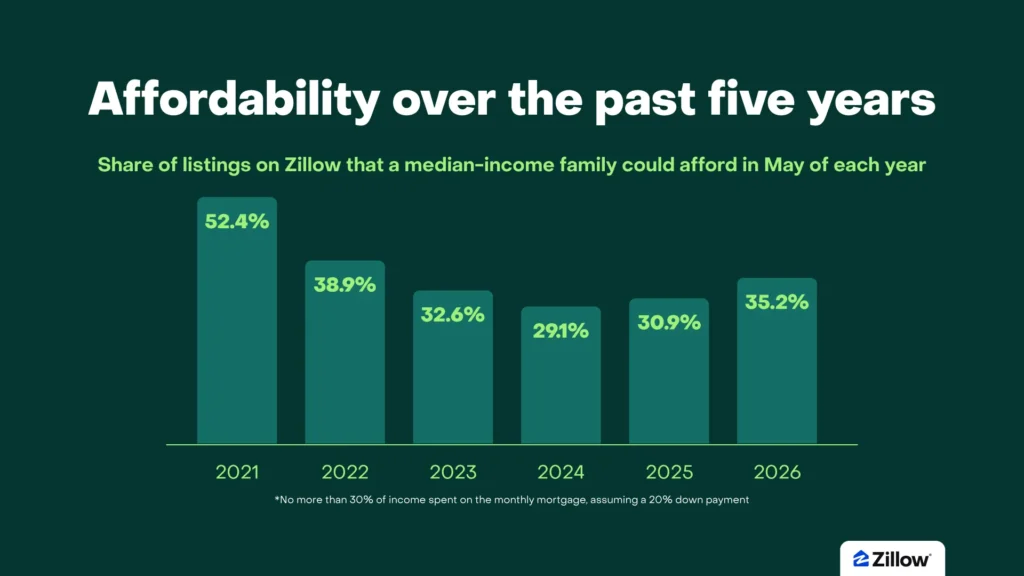
As of 2026, the percent of listings on Zillow that can be considered affordable is around 35.2%. Still a far cry from the 2021 decline.
Any improvements in affordability, however, seem to have skipped the most expensive markets in the nation where building new units can be challenging for myriad reasons, including zoning and building regulations and political battling.
Read More: Los Angeles to build largest speed camera network in California
“Among big metros, the shortage is deepest in Boston, followed by San Diego and Los Angeles. In New York, Los Angeles, Boston and San Francisco, the share of affordable listings sits in the low-to-mid teens or below, against 35% nationwide,” Zillow writes.
In most of the nation’s major cities, “starter homes,” which were at one point considered the entrypoint into property ownership, now cost more than $1 million—a record, a three-times higher figure than only six years ago.
Earlier this year, Zillow reported that housing and rental prices were falling in the Sun Belt region of the U.S. where there are far fewer challenges to get new construction completed.
What’s being done to address the housing crisis?
With new federal laws on the books, ones that Zillow has admittedly lobbied for specifically, some of these building roadblocks might be easier to clear moving forward.
The affordability crisis is one that affects everyone, Divounguy said, adding that bipartisan solutions from congress have been “encouraging.”
According to Zillow itself, cities can do more, and the company thinks they should. Among the possible solutions include loosening restrictions on duplex and townhomes in neighborhoods and cities that only allow single family homes. Zillow officials say they also want it to be easier to build backyard cottages and accessory dwelling units (ADUs), expand manufactured housing and speed up approval processes for building on vacant lots.
It’s important to note that Zillow is among the most prominent real estate and rental listing services in the world, so more properties to list and advertise is beneficial to its business interests.
Still, the data backs up a point that many urbanists and housing advocates have long been hammering: more houses equals lower prices.
While 2024’s construction wave is arguably proof of this concept, it’s not nearly enough to address the national shortage.
“Closing a 4.7 million-home gap is a different job than simply not widening it,” Zillow writes. “Whether it starts to climb depends on what happens when the pandemic building boom runs dry.”
For more stories like this, follow Rabble News on Instagram and Facebook.
