


The California High-Speed Rail is finally becoming an actual railroad.
That’s according to California High-Speed Rail Authority CEO Ian Choudri’s June 2026 report released Thursday.
Choudri described the current status of the highly ambitious yet much-maligned transit project as finally—after years of delays, criticism and calls for it to be abandoned altogether—reaching the turning point into becoming a reality.
“June marks one of the most consequential months in the history of the California High-Speed Rail program,” Choudri said in the Authority’s CEO report. “For the first time, we are moving beyond planning and major civil construction and into becoming a railroad.”
Choudri highlighted the selection of a track and systems contractor and the adoption of a new business plan as major milestones reached in recent weeks, saying that the stars are beginning to align to “deliver the nation’s first true high-speed rail system.”
Earlier this week, we reported that the California High-Speed Rail Authority had selected the joint venture construction consortium of Kiewit, Stacy Witbeck, and Herzog to install the very first track in the project’s history.
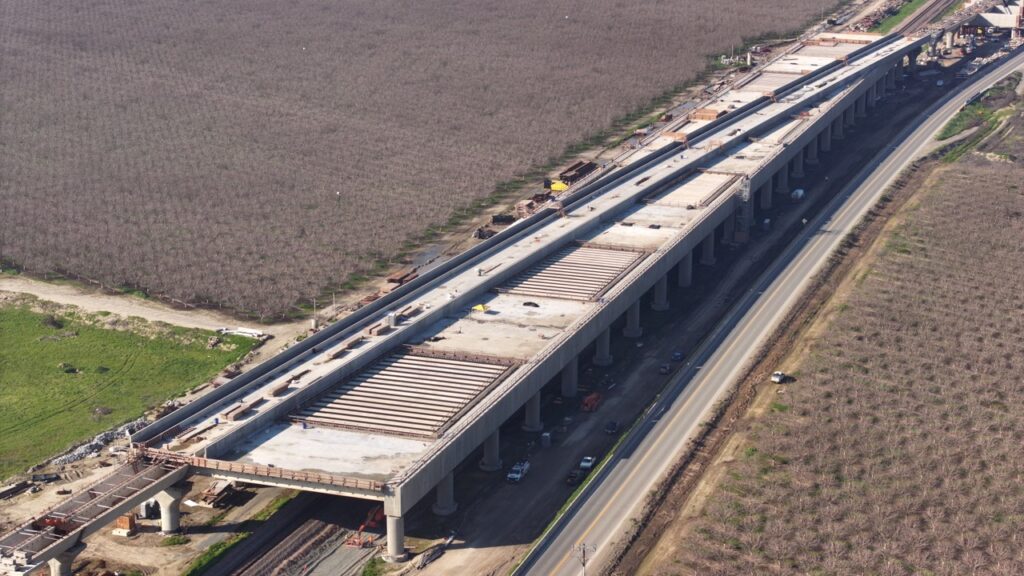
Construction crews will begin laying track, installing overhead electrical catenary systems, and build out control and communications infrastructure along 119 miles of completed guideway in California’s Central Valley.
While the long-awaited laying of track may seem like it should’ve been done years ago, early in the project’s infancy, it’s actually one of the more simple tasks in the grand scheme. The California High-Speed Rail Authority has spent years completing the tedious legal and clerical work of building the system, including design and approval, public feedback, land and right-of-way acquisition, relocation of utilities and building massive over- and under-passes to keep the train grade-separated from vehicle traffic.
Laying track is a major milestone, but Choudri used his CEO update to highlight the significant work that has been done behind the scenes leading up this point.
“This progress did not happen overnight,” Choudri said. “Over the last 18 months, the Authority focused on creating the conditions necessary to accelerate delivery, strengthen financial sustainability, and prepare the program for its next phase.”

Among the major wins for the Authority under Choudri, the California legislature approved a $1 billion annual funding deal for the next 20 years to allow the project to obtain consistent funding—something it didn’t have previously.
The steady funding allows the Authority to take out loans and obtain public-private partnerships to accelerate the construction timeline.
Choudri said the Authority also “reorganized” and strengthened its relationships with its numerous stakeholders, modernized its design standards to align with best practices used in Europe and Asia, and began the process of procuring materials and equipment that require long lead times and need to be ordered several years in advance.
Ultimately, Choudri said the changes instituted since he was sworn in as CEO in September 2024 involved improving efficiency and streamlining costs.
“Together, these actions have created the foundation for what comes next: track laying, installing systems, and preparing for operations,” Choudri added.
What’s next for the California High-Speed Rail?
In the coming months, active construction will expand beyond the 119-mile segment in the Central Valley with extensions toward Merced and Bakersfield. That will allow the High-Speed Rail to connect more easily with regional transportation networks near the Bay Area and Southern California to allow for some form of service to begin on an accelerated timeline before the entire system is built out.
The Authority is also trying to obtain some environmental exemptions from the state in order to build renewable power sites, which will power the high-speed trains while also contributing the wider goals the state has regarding climate and clean energy.
Choudri says the Authority is also trying to speed up the permitting process to allow the system to tap into additional revenue streams.
The relocation of utilities continues to be among the biggest roadblocks that the authority is facing and is “largely outside our control,” Choudri said. The process of relocating these utilities so construction can take place is described as “costly” and “unpredictable,” and the Authority says it is working to push for change at the legislative level to make that process go smoother.
But among the biggest changes under Choudri’s stewardship is the component of private-public partnerships. Choudri has pushed for bringing on more stakeholders from the private sector to add more bulk to the Authority’s powers and purse. That strategy, he says, is now becoming a reality.
“The Authority’s strategy remains straightforward: build smarter, deliver earlier, and create the strongest possible foundation for future expansion,” Choudri concluded. “For the first time, California high-speed rail in bringing together the builders, operators, investors, designers, and systems experts needed to transform completed infrastructure into an operating railroad.”
Choudri said the plan is to accelerate the timeline so that Californians can finally experience the long-promised reality of Los Angeles to San Francisco by high-speed rail.
The Authority says it is working on making it happen “as soon as possible.”
